
Assessment of dynamic cerebral blood flow changes during cognitive tasks in patients with post-COVID-19 syndrome
Kutz, Dieter F.; Garbsch, René; Mooren, Frank C.; Schmitz, Boris; Voelcker-Rehage, Claudia
Forschungsartikel (Zeitschrift) | Peer reviewedZusammenfassung
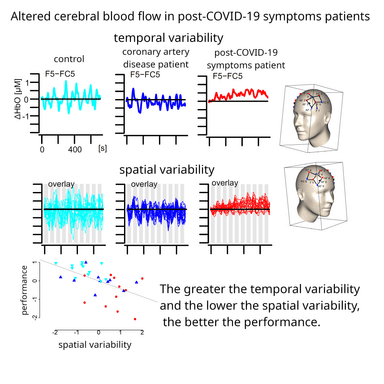
The objective of this study was to quantify the variability of cortical blood flow during cognitive load as an indicator of disease-related changes in cerebral capillary blood flow intermittency in patients with post-COVID-19 syndrome. The regulation of cerebral blood flow in the dorsolateral prefrontal cortex under cognitive load was examined using high-resolution functional near-infrared spectroscopy in 36 subjects including 12 patients with post-COVID-19 syndrome and two control groups [12 coronary artery disease patients matched for age and 12 young healthy individuals (CTRL)]. To induce cognitive load, a Flanker task and an N-back task were employed. The structure of temporal variability of local blood flow regulation was assessed using sample entropy at 17 channels spanning both brain hemispheres. The spatial variability of the regional blood flow pattern was evaluated using the coefficient of variation (CV) from sample entropies across all channels. Results revealed a notable discrepancy in that patients with post-COVID-19 syndrome exhibited reduced temporal variability (lower sample entropy) but elevated spatial variability (higher CV) in comparison to coronary artery disease patients during cognitive load (P = 0.02). In the N-back task, the spatial variability increased from healthy individuals to coronary artery disease patients to patients with post-COVID-19 syndrome and was associated with longer reaction time and with lower accuracy. The results confirmed that dynamic cerebral blood flow is altered in patients with post-COVID-19 syndrome, which may be related to fatigue during cognitive tasks. Sample entropy and CV values represent different aspects of blood flow regulation fluctuation. Their simultaneous analysis enabled a meaningful distinction between groups suggesting disease-related changes in brain haemodynamic. The presented method is therefore suitable for describing current states of cortical blood flow regulation and for documenting intervention results in patients with post-COVID-19 syndrome or patients with similar symptoms (e.g. myalgic encephalomyelitis/chronic fatigue syndrome).
Details zur Publikation
Autor*innen der Universität Münster
| Kutz, Dieter Friedhelm | |
| Voelcker-Rehage, Claudia |